
DNLU VC: ‘LLB students staying back for LLM is good sign for a university our age’
Musab Qazi | January 19, 2026 | 04:55 PM IST | 7 mins read
NLU Jabalpur VC on LLM and legal PhD courses; why AI should just be an assistive tool; and how state support is essential to prevent law course fees from rising
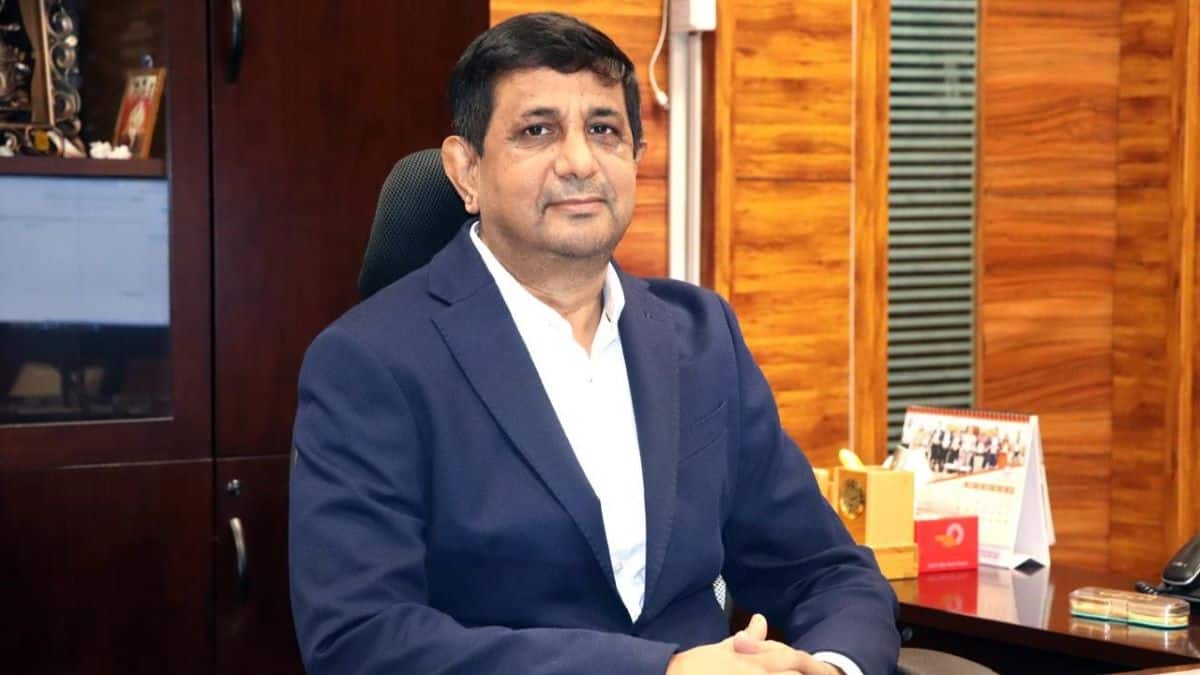
Established in 2018, Dharmashastra National Law University (DNLU), Jabalpur, is one of the younger entrants in India’s growing list of NLUs. As the institute navigates its transition from its temporary BSNL building to a large permanent campus, VC Manoj Kumar Sinha spoke to Careers360, discussing the progress of the new campus, the university’s unique success with its PhD and LLM programmes, and why he believes the government must continue to fund public institutions to prevent the burden of costs from falling on students. Edited excerpts:
How would you describe DNLU Jabapur's progress in terms of both academic development and the physical campus since it was set up in 2018?
I believe sufficient progress has been made. Since our establishment, DNLU has been one of eight National Law Universities added across the country. Despite being a relatively young institution, we have steadily built our academic framework and institutional systems.
With respect to infrastructure, the state government has allotted us land for our permanent campus. Construction of the hostels is underway, and the construction work for academic and administrative building will commence soon.
As for academics, we offer the BA LLB (Hons) with two sections, as well as LLM and PhD. I am very happy to share that we have already produced eight to nine PhDs. For a university of our age, that is a significant achievement.
Our faculty is another strength. Most of them hold PhDs, and many have been educated at top NLUs. Having teachers who understand the NLU culture from the ground up is vital.
The undergraduate students at DNLU are increasingly choosing to stay back for their LLM. It is a good sign for any institution. In NLUs, the trend is usually to move to an older NLU for postgraduation.
Also read ‘Decision-making at WBNUJS Kolkata was centralised, led to student protest’: VC on restoring trust
What’s the reason for this trend?
Around 10% to 15% of our LLM batch come from our own undergraduate pool. However, most of our graduates prefer to pursue their postgraduate studies at other NLUs and abroad.
I think it comes down to faith and trust. We give equal importance to LLM and PhD programmes, which students sometimes feel are missing elsewhere. Our focus areas in LLM are business laws and criminal laws. When students interact with their seniors, see classes are being conducted sincerely and the environment is conducive, they choose to stay. Of course, the state reservation and economic factors play a role.
We have signed several memoranda of understanding (MOUs) with other NLUs and even private players like Bennett University. But executing them can be a little tricky.
What are the roadblocks?
The primary challenge lies in execution. While signing an MoU reflects mutual intent, its success ultimately depends on active participation from both institutions. Effective collaboration requires sustained engagement, regular follow-ups, and clear institutional commitment from each side.
On paper, ideas such as faculty exchange, student exchange programmes, and joint academic seminars are extremely promising. However, in practice, the level of responsiveness varies. Some partner institutions are highly proactive and take these collaborations forward, while others take longer to move beyond the initial documentation stage.
What are the focused research areas of the institute?
We have several research centres, some of which are doing great work. We give all the centres autonomy, liberty to think and execute while supporting them as administration.
Also read CLAT exam, NLU admission costs are ‘a barrier’ to studying law: Students
A Supreme Court (SC) report has noted that many law school legal aid cells are inactive. What’s the status at DNLU Jabalpur?
At DNLU, our legal aid committee is fully functional and actively engaged in community outreach. It works closely with the Madhya Pradesh State Legal Services Authority. The Madhya Pradesh High Court also engages us in many activities, such as legal aid and mediation, in Jabalpur as well as in Indore. Last year, we conducted a three-day training programme for government officials in collaboration with the Institute of Constitutional and Parliamentary Studies (ICPS), New Delhi. Our proximity to the High Court and surrounding villages provides a unique opportunity.
It allows our students to engage directly with underprivileged communities and gain hands-on experience in addressing real legal problems, which is central to clinical legal education.
Any new academic programmes in the pipeline?
Recently, there was a meeting in Delhi chaired by law minister Arjun Ram Meghwal where several NLU VCs participated. The Bar Council of India (BCI) has since issued directions to all law schools to include courses in legislative drafting and plain English. We are now integrating these subjects with the existing clinical courses. We are exploring contemporary topics like deep-sea mining and artificial intelligence (AI), as suggested by Prime Minister Narendra Modi.
NLUs have acquired a reputation as ‘elitist’ institutes due to their high fees. How is DNLU ensuring inclusivity for students from disadvantaged backgrounds?
Students from economically weaker sections who secure admission to NLUs are eligible for scholarships offered by their respective state governments. In Madhya Pradesh, there’s a comprehensive scholarship scheme that covers a substantial portion of educational expenses. Central government scholarships are also available. There are bank loans as well. In states like Jharkhand and MP, the government is very proactive about supporting higher education of disadvantaged students.
Also read Litigation to corporate law: A first-generation lawyer's journey from burnout to breakthrough
Beyond financial aid, students from the hinterland often struggle to mix in. What are you doing to help them acclimatise?
We have dedicated language instructors to support students who face communication barriers. We also encourage students to interact directly with faculty, and whever difficulties are identified, we organise remedial classes. If students come forward and express a need for assistance, we are fully committed to providing it.
How are you integrating AI into the curriculum?
Science is constantly evolving -- today it is artificial intelligence, and tomorrow it may be something else. We cannot and should not prohibit scientific development. However, I firmly believe that AI must be used strictly as an assistive tool. If human intelligence becomes subordinate to technology, that would be problematic.
Star Blurb As educators, we understand our students’ capabilities. When a student suddenly produces work that is inconsistent with their usual academic engagement, it raises red flags. We therefore focus on sensitising students to the ethical and moral dimensions of using AI.
At a broader level, I believe the University Grants Commission (UGC) should formulate a clear and uniform regulatory framework, similar to the 2018 academic integrity and plagiarism guidelines, to govern the academic use of AI.
The Delhi High Court recently suggested that no student should be barred for lack of attendance. What is your take?
National Law Universities are residential institutions, and since most students reside on campus, attending classes is essentially their primary responsibility. The Bar Council of India (BCI) prescribes a minimum attendance requirement of 70%, although some institutions have increased this threshold to 80% or even 90%.
However, the 70% requirement is not that difficult to achieve. That said, I appreciate that the Court has taken into account genuine student concerns such as mental health and language barriers. In our case, we have the discretion to condone up to 5% shortage for legitimate academic activities such as moot courts, effectively reducing the requirement to 65%.
We also provide remedial classes when the shortage is marginal, around 5–6%. However, if a student remains absent for a substantial part of the semester, institutional flexibility becomes limited.
I believe that the judgment has larger implications for non-residential colleges, not NLUs. If we monitor attendance continuously and keep the attendance record updated, as directed by the court, we can usually resolve issues before they become genuine crises.
There’s also the issue of the judgment’s applicability outside Delhi. It’s an open-ended question at the moment. The order can be deemed to have wider applicability.
Also read Law schools slowly relax attendance rules as LLB students seek internships, flexible learning
Students are keen to have a window available to them in the fourth and fifth years of UG programme to pursue law internships. Does DNLU have such a provision?
No, because no regulation permits the colleges to do away with the 70% attendance mandate. But we have extended vacations – almost two months summer break and one-and-a-half months winter break.
Many public institutions are being urged to become self-sustaining and raise funds on their own. Have you found any alternative revenue streams?
I strongly believe that compelling public universities, whether Delhi University, Jawaharlal Nehru University, or NLUs, to adopt a fully self-sustaining model will ultimately burden students. Education must remain affordable and accessible.becoming a privilege reserved for a few.
If institutions are expected to generate their entire operational expenditure independently, the inevitable consequence will be an increase in student fees, without any corresponding assurance of employment.
Some measure of funding – at least 20-30% – from the state is essential to protect public institutions, which are desperately in need of support. I sincerely hope that the government continues to help higher education so that it remains a tool for social mobility rather than a becoming a privilege reserved for a few.
 Add as a preferred source on google
Follow us for the latest education news on colleges and universities, admission, courses, exams, research, education policies, study abroad and more..
To get in touch, write to us at news@careers360.com.
Next Story
]Latest Education News
]Related News
]Maharashtra eases university teacher recruitment norms; academic weightage cut to 60% from 75%
JEE Mains 2026: NIT Surathkal BTech CSE cut-off trends; 2800 rank for open seats
JEE Mains 2026: BTech Electrical Engineering cut-offs highest at NIT Rourkela among all NITs, IIITs, GFTIs


