
Caste on Campus: The shape of discrimination in universities and why many back UGC equity regulations
Azib Ahmed | February 9, 2026 | 12:24 PM IST | 8 mins read
SC, ST, OBC student lives tainted by discrimination – in exams, interviews, classrooms, and from peers, teachers, university officials. It’s why they back UGC equity regulations 2026

Colleges/Universites Accepting CUET Score
Download list of Colleges/ Universities Accpeting CUET Score with Cut-OFFs
Download Now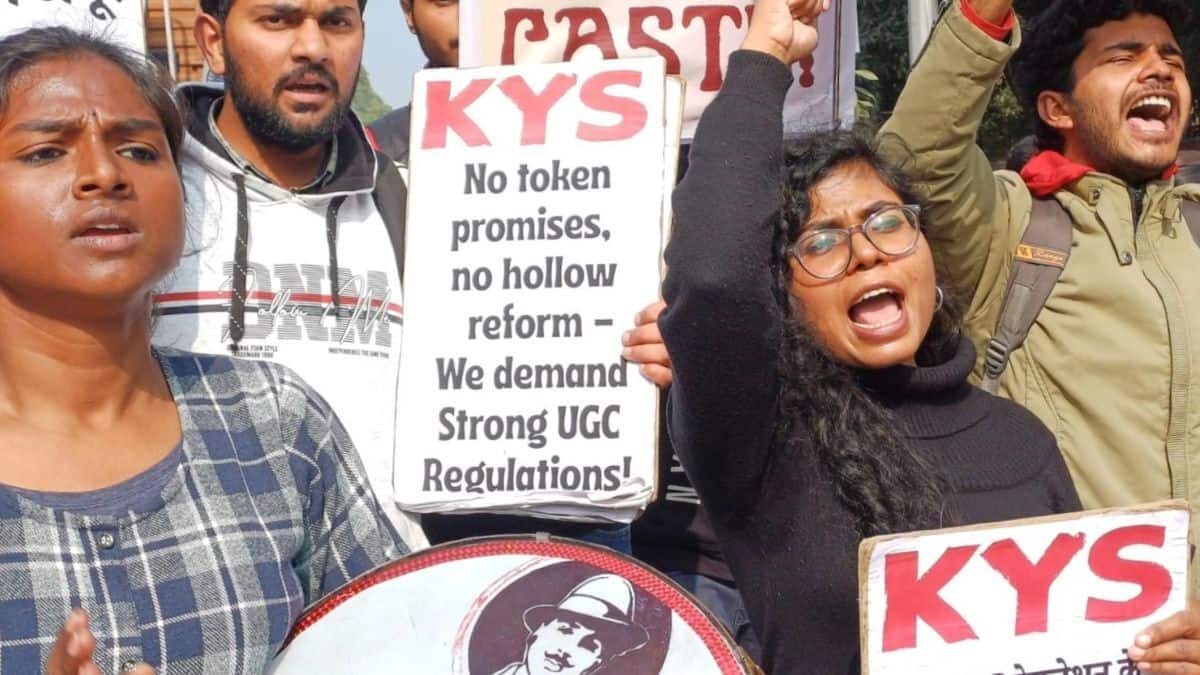
When Das, a BA Sanskrit student at a Delhi University college, went to get her exam admit card signed, she placed her phone charger on the official’s table and saw him cringe and shrink away. He next asked her to stand at a distance and finally told her, “Don’t study and ruin others’ seats”.
Don't Miss: NIRF DU Colleges Ranking
Das, who asked that only her last name be used, is from Bihar and belongs to the historically-marginalised Scheduled Castes for whom 15% seats are reserved in central institutions by law. She needed her admit card signed urgently and opted not to argue but noted the aggression and sees it as rooted in caste bias. Das described such moments as “subtle but mentally-exhausting reminders of caste on campus”, the sort of slights that the University Grants Commission (Promotion of Equity in Higher Education Institutions) Regulations, 2026 might describe as “discimination…explicit or implicit”. The UGC is the apex higher education regulator in the country.
The UGC equity regulations have caused a furore, especially among the “general category” – the historically-dominant upper-castes – who argue the regulations, if implemented, would "create chaos" on campuses. The definition of caste discrimination is too vague and there is no punishment for “false cases”, they said. A video was circulated to bolster the false-case point, with claims that such an incident occurred in another DU college, Shri Ram College of Commerce; SRCC debunked it.
The Supreme Court has stayed the regulations, meant to protect students from discrimination, “explicit or implicit”, based on caste, religion, race, gender, place of birth or disability. But students and scholars from Scheduled Castes, Scheduled Tribes and Other Backward Classes (SC, ST, OBC) across universities say caste bias remains a reality that is not always open, but often seen in hostile interviews, internal assessment marking, lopsided disciplinary action, and daily campus interactions.
Conversations with students from Lucknow University, Delhi University, Allahabad University and Mahatma Gandhi Antarrashtriya Hindi Vishwavidyalaya Wardha show that while discrimination may look different today, it still affects students’ academic and social lives.
Caste in interviews and exams
Gangasagar Nishad, 25 and pursuing a PhD in ancient Indian history and archaeology at Lucknow University, believes the UGC equity regulations could serve as a deterrent. “Those who discriminate will not be able to do it easily. These rules give legal backing,” Nishad said.
Nishad belongs to the Mallah (Nishad) community, an OBC group traditionally linked to boat-making and river-based work. His community has faced untouchability and social exclusion in the past. In the present, the expression of bias is more subtle.
Nishad scored the highest in the Research Eligibility Test (RET) for PhD admissions – across all categories – but just 10 out of 20 in the interview. He feels he deserved more. “Sometimes it feels indirect. No one will openly say they are giving fewer marks because of caste, but it can happen,” he said.
Interviews and viva voce exams, he argued, are subjective spaces where bias may play a role. If panels are dominated by upper-caste faculty, lower-caste candidates may not receive equal preference, he said.
Academic progress by students whose families have faced generational exclusion from education is dismissed. “People say, ‘You are here because of quota, otherwise you would be doing labour work’,” said Nishad.
Grades awarded can change. He alleged that his sister, a student at Babasaheb Bhimrao Ambedkar University (BBAU), Lucknow, was shown an ‘A’ grade in class but finally downgraded to ‘B’ on the final report card. He suspects bias because casteism is just that entrenched in the system. He faced belittling remarks even in school with a teacher deliberately using his caste name.
‘Proudly upper-caste’
Name-calling and derision based on caste are common. When Das’ family moved from Bihar to Kolkata, West Bengal, her father changed the family name –a dead giveaway for their caste – to the more ambiguous ‘Das’ and advised his daughter to conceal her identity. She listened and went through her first semester in DU without revealing her background.
She found her classmates making casteist remarks “very comfortably”. Even a professor made derogatory remarks linking students’ food habits to their caste, asking, “You people must have eaten beef or pork?” Another ‘friend’ attributed their failure to get into an Indian Institute of Technology (IIT) to reservation.
Once she joined the left-leaning Students’ Federation of India (SFI) and began talking about her caste identity openly, Das’ friends’ behaviour changed. One shifted away when she placed her bag nearby; peers, some of whom described themselves as “proudly upper caste” on social media, kept their distance.
Das’ nomination for a college union election was cancelled; when she sought a reason, she was told there was “no point” because only a limited number of students would vote for her. She viewed this as indirectly linked to caste.
Caste and campus politics
Shantam Nidhi, 26, a master's student at Lucknow University and member of All India Students’ Association (AISA) referred to cases like Rohith Vemula, Payal Tadvi and Darshan Solanki as examples of “institutional discrimination”. All three took their own lives, between 2016 (Vemula) and 2023 (Solanki), and in different types of institutions. Vemula was a research scholar at University of Hyderabad; Tadvi and medical student at Topiwala National Medical College and Solanki, an engineering student at IIT Bombay.
Punishments and violence are meted out to Dalits with a freer hand. Nidhi pointed to lesser-known cases as well. In 2022, a student linked to the Akhil Bharatiya Vidyarthi Parishad assaulted a Dalit professor, Ravi Kant, at Lucknow University. For long after the attack, Kant faced relentless casteist abuse within the university, said Nidhi. In another case, the member of a proctorial team on a routine inspection allegedly slapped a Dalit scholar near the university’s Tagore Library for “sitting improperly.”
Also read With few Dalit, Adivasi teachers, IITs, IIMs lack ‘environment of empathy’: AIOBCSA president
Although Nidhi is upper-caste, they argue that inaction from the similarly-upper-caste university administration after such incidents can be perceived as tacit support and emboldens attackers.
The university administration refused permission for a march organised by the Birsa-Ambedkar-Phule Students’ Association (BAPSA) on January 17 to mark the 10th death anniversary of Rohith Vemula. When BAPSA marched anyway, ABVP tried to stop it and clashes broke out. Events related to Dalit icons – such as Ambedkar Jayanti – or on anti-caste themes often face resistance or disruption on campuses across India, he said.
‘Discrimination in many forms’
Rajesh Kumar Yadav, a PhD scholar in women’s studies at MGAHV Wardha, said discrimination often happens through procedures. “You will find discrimination in many forms – attendance manipulation, delayed fellowships and hurdles in research approvals,” he said.
Admitted in 2021 to work on ‘media portrayal of women’, his PhD registration was cancelled in 2024, keeping him out for nearly two years. He linked this to protests he took part in, including wearing black on January 26, 2024, and believes caste played a role. “Proper procedures, like forming a committee and giving prior notice, were not followed before action was taken.” He added that while students from upper-caste backgrounds were also protesting, the university picked those belonging to SC, ST, and OBC communities for punitive action.
Another Dalit scholar from the same university was suspended for two years over social media posts.
Caste identity visible through admission records, Yadav alleged that attendance rules are sometimes used to pressure marginalized students. “As soon as a student joins, their name and category are known. Teachers have full authority to mark students present or absent, reduce attendance percentages, and sometimes stop students from sitting in exams due to low attendance.”
‘Discrimination feels routine’
Manish Kumar, 30, a political science PhD scholar at Allahabad University, described discrimination as “structural and routine”. Even when students qualify in the general merit list, they are often “pushed back into their category,” he noted.
He alleged that if Dalit and backward-caste students are vocal and assertive about their rights, they sometimes face harsher treatment, including beatings without cases being filed. Professors who speak on caste issues face pressure from right-wing groups.
Kumar himself was suspended for one-and-a-half years and had to approach Allahabad High Court to get it revoked.
“We get beaten for caste, suspended for caste, marked down for caste, and called out for caste,” Kumar added.
UGC Equity Regulations 2026: Protests in support
Since the SC stayed the UGC equity regulations, student groups have started protesting on several campuses. They demand that the regulations be implemented and say they are needed to address caste discrimination.
While students said the UGC rules are necessary to improve complaint systems and check discrimination, they also pointed to gaps that could limit their effectiveness. Nidhi pointed out that the older 2012 rules were also not properly followed and that the probe committees can only suggest action; the final decision is taken by university authorities most of whom, he believes, are upper-caste.
Plus, reservation is being increasingly used to distract from the shortage of resources. “Students are made to believe their seat is gone because of reservation, so they don’t question the real issue – the shortage of seats,” he said. “If there are 100 students and only 10 seats, the anger is diverted toward reservation instead of asking why there aren’t more seats.”
Although frequently confused with it, the equity regulations are not related to the Viksit Bharat Shiksha Adhishthan Bill which seeks to replace the UGC and some other regulators with a new body. The VBSA Bill - often and erroneously referrred to as the "UGC Bill" - is currently with a joint parliamentary committee.
If you know someone – friend or family member – at risk of suicide, please reach out to them. Those in distress or having suicidal thoughts or tendencies could seek help and counselling by calling 9820466726 or visiting AASRA’s official website or can call iCALL on 9152987821. Here are some more helpline numbers of suicide prevention organisations that can offer emotional support to individuals and families.
 Add as a preferred source on google
Follow us for the latest education news on colleges and universities, admission, courses, exams, research, education policies, study abroad and more..
To get in touch, write to us at news@careers360.com.
Next Story
]Latest Education News
]Related News
]MCC NEET Counselling 2026 LIVE: Registration for MBBS, BDS AIQ quota seats at mcc.nic.in from tomorrow
Maharashtra Private Medical College Fee Revision: SMBT MBBS fee cut by Rs 81,500, others see hikes
Tamil Nadu CM unveils Rs 274.46 crore higher education infrastructure projects


