
Students, teachers launch signature campaign to oppose VBSA Bill 2025
Sundararajan | February 4, 2026 | 11:30 PM IST | 3 mins read
Campaign against the Viksit Bharat Adhishthan Bill highlights threats to public higher education, rising fees, and reduced equity safeguards
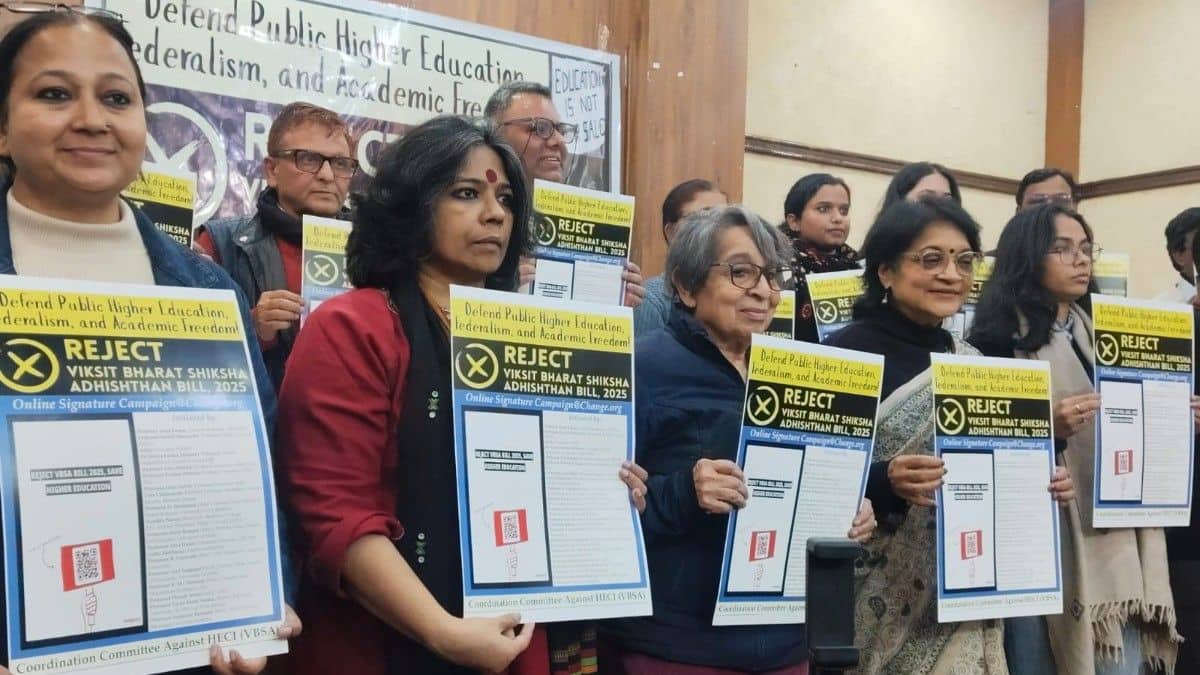
Student and teacher groups, as well as a section of members of parliament, came together in Delhi on Wednesday to launch a nationwide signature campaign against the Viksit Bharat Shiksha Adhishthan (VBSA) Bill 2025.
Urging students, teachers, and citizens to demand the withdrawal of the bill and protection for public and autonomous higher education, the Coordination Committee Against HECI – an umbrella group of teacher and student organisations – warned that the VBSA poses a threat to public higher education, federalism, and academic freedom.
The campaign shared articles and other resources to explain how the bill relates to current problems in universities, rising fees, and reduced protections for equality.
The VBSA Bill was tabled in parliament in the winter session, but was referred to a joint parliamentary committee after strong opposition from MPs, as well as the chair of the parliamentary standing committee on education.
UGC Equity Regulation 2026: Withdrawal
The conference also addressed the withdrawal of the UGC Draft Equity Regulations 2026, which are designed to promote equality, inclusion, and safeguards for Scheduled Caste (SC), Scheduled Tribe (ST), Other Backward Classes (OBC), and minority students.
The speakers highlighted that the VBSA bill would dissolve existing regulatory bodies such as UGC, AICTE, and NCTE, and replace them with a single centralised authority controlled by the government.
“Universities will lose their autonomy, and institutions and faculty members who do not comply with the regulations will face penalties, including the suspension of funding. Without financial support, educational institutions will inevitably raise fees, making higher education unaffordable,” said Surajit Mazumdar, president of FEDCUTA.
VBSA Bill 2025: ‘Intentional political move’
“The VBSA Bill is an 'intentional political move' that weakens protections for marginalised students and imposes ideological and corporate control,” social justice activist Lakshman Yadav said.
“The fees at Ambedkar University Delhi already range from Rs 20,000 to Rs 25,000, which is higher than at many other public universities, and scholarships and fee waivers are often delayed or denied,” said Sharanya, treasurer of the AUD students’ council.
“The VBSA formalises the ongoing oppression and surveillance in universities; this includes punitive actions against SC and ST student representatives and actions against suspended leaders,” said Aditi, JNUSU President.
Also read Teacher recruitment to scholarships – what SC wants universities to do for suicide prevention
VBSA targets autonomy, regulatory bodies
Bihar MP Raja Ram Singh and Tamil Nadu MP Kalanidhi Rajasamy criticised the bill, stating that it undermines state autonomy in education and threatens access for Dalit, oppressed, and economically disadvantaged students.
“VBSA, inspired by the National Education Policy (NEP), aims to standardise higher education and pave the way for its corporatisation, while also seeking to dismantle bodies like the UGC, All India Council for Technical Education (AICTE) and the National Council for Teacher Education (NCTE),” said Arun Kumar, general secretary of AIFUCTO.
Member of Rajya Sabha from Delhi, Sanjay Singh criticised the low government spending on education. He noted that less than 5% of the national budget is allocated to education. He also highlighted school closures in UP that force children to travel long distances, showing the real-life impact of underfunding.
 Add as a preferred source on google
Follow us for the latest education news on colleges and universities, admission, courses, exams, research, education policies, study abroad and more..
To get in touch, write to us at news@careers360.com.
Next Story
]Latest Education News
]Related News
]UP NEET PG round 3 dates revised again; 8,935 register, lowest score at -20
Maharashtra eases university teacher recruitment norms; academic weightage cut to 60% from 75%
JEE Mains 2026: NIT Surathkal BTech CSE cut-off trends; 2800 rank for open seats


