
Education Budget 2026 LIVE: Rs 1.39 lakh crore for higher ed, schools; new NID, NIPERs, NIMHANS; skilling push
Anu Parthiban | February 2, 2026 | 07:39 AM IST | 31 mins read
Union Budget 2026 Education: 3 new NIPERs, 5 university townships, 1 new NID, boost to ICAI, ICMAI, allied health sciences – Nirmala Sitharaman speech highlights on education, skill development and employment
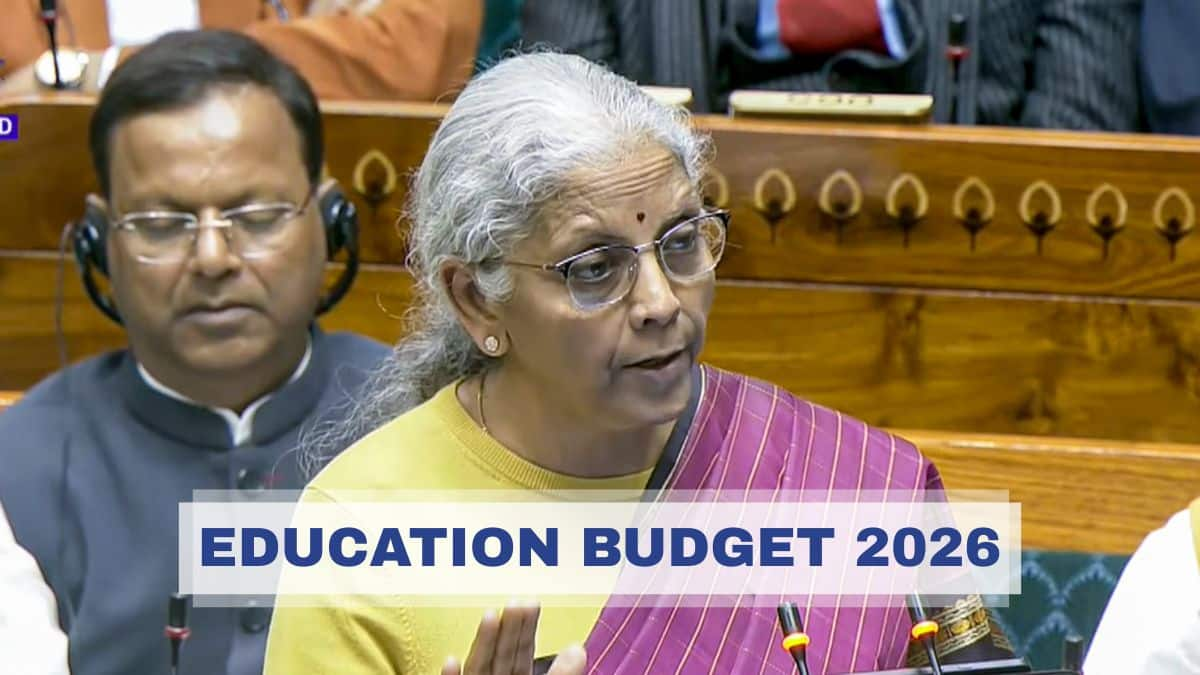
Budget 2026 Education: For the fiscal year 2026-27, the education sector has received an allocation of Rs 1,39,289.48 lakh crore. Finance minister Nirmala Sitharaman has announced three new National Institutes of Pharmaceutical Education and Research (NIPER), one new National Institute of Design (NID) and support for five new university townships in her budget speech 2026.
Out of the total allocation for the Education sector, Rs 83,562.26 crore has been allocated to school education, and Rs 55,727.22 crore for higher education.
While these were among the budget highlights, she also announced a host of new skilling programmes across industry sectors – including shipping, tourism and more – as well as a major boost to accounting professions managed by the ICAI, ICMAI and others and the allied and healthcare professions.
The FM presented her 9th budget speech today for the first time in Kartavya Bhavan.
Education Budget 2026-27: Highlights
Notably, 3 new All Institutes of Ayurveda (AIIAs) will be established. The minister has a set goal of including one lakh allied and healthcare professionals over the next five years.
The emphasis on allied health professionals (AHPs) comes after the Centre’s ongoing efforts to standardise training for allied health science programmes through the National Commission for Allied and Healthcare Professionals (NCAHP).
The finance minister stated that the skilling initiatives will span 10 disciplines, including anaesthesia, optometry, radiology, operating theatre technology, applied psychology, and behavioural health.
Another National Institute of Mental Health and Neuro Sciences (NIMHANS) will be established in northern India. Currently, one NIMHANS is in Bengaluru. Additionally, through Viability Gap Funding or capital support, one girls' hostel in every district for STEM students will be established.
Last year, under the Education Budget 2026, the sector received an allocation of Rs 1,28,650.05 crore, marking a 6.65% rise. The education sector continues to urge the government to increase spending to 6% of GDP in line with the National Education Policy (NEP 2020) targets.
Spending on higher education rose by 7.74% to Rs 50,077.95 crore in 2025-26, while the school education and literacy department was allotted Rs 78,572 crore, nearly Rs 11,000 crore higher than the revised estimates.
 Add as a preferred source on google
Follow us for the latest education news on colleges and universities, admission, courses, exams, research, education policies, study abroad and more..
To get in touch, write to us at news@careers360.com.
Union Budget 2026 Education: 3 new NIPERs, 5 university townships, 1 new NID, boost to ICAI, ICMAI, allied health sciences – Nirmala Sitharaman speech highlights on education, skill development and employment

February 2, 2026 | 07:39 AM IST
Union Budget 2026 a human-centric roadmap to Viksit Bharat: IIM Kozhikode Director
Calling the Union Budget 2026 a forward-looking blueprint rather than just a fiscal exercise, Debashis Chatterjee, Director IIM Kozhikode, said it places human capital at the core of India’s growth strategy. He highlighted the focus on youth, skilling partnerships with premier institutions, MSMEs, women-led enterprises and sunrise sectors, noting that investments in tier-2 and tier-3 cities, innovation and institutional capacity will help build a resilient, self-reliant and globally competitive India.
February 2, 2026 | 07:33 AM IST
Union Budget 2026: Govt pushes astronomy education with telescope upgrades
Union budget 2026 saw announcement of a fresh emphasis on astronomy education, with plans to modernise major telescope facilities such as the National Large Optical Infrared Telescope and the Himalayan Chandra Telescope. Alongside infrastructure upgrades, the proposal includes the launch of the Cosmos-to-Planet TV programme, designed to encourage interactive learning and expand public interest and participation in astronomy and astrophysics.
February 2, 2026 | 07:11 AM IST
Union Budget 2026: Modular courses, hostels and education hubs to transform apprenticeships, says TeamLease CEO
Welcoming union budget 2026, Nipun Sharma, CEO of TeamLease degree apprenticeship, said short-term modular courses with Institute of Chartered Accountants of India (ICAI) will help bridge a 47% compliance skill gap and support India’s 6.3 crore MSMEs through locally trained “Corporate Mitras”. He also highlighted the Rs 10,000 crore district hostel scheme as a key enabler for women’s participation, noting a 58% rise in female apprentices since 2021, and said education hubs near industrial clusters could cut migration-linked attrition by 25–30% while strengthening work-integrated learning.
February 1, 2026 | 10:29 PM IST
Union Budget 2026: TCS reduced to 2% on education.
The Union budget 2026 saw a significant reduction in the tax collected at source (TCS) for certain transactions. The TCS rate on remittances made for education will be lowered from 5 per cent to 2 per cent.
Under the revised proposal, remittances exceeding Rs 10 lakh for education or medical treatment will attract a TCS of 2 per cent, instead of the existing 5 per cent. The Liberalised Remittance Scheme allows resident individuals, including minors, to remit up to USD 2,50,000 per financial year for permitted current or capital account transactions. However, remittances made for purposes other than education and medical treatment will continue to attract a higher TCS of 20 per cent.
February 1, 2026 | 10:12 PM IST
Union Budget 2026: Mixed funding signals for research, fellowships and apprenticeship schemes
The Union Budget 2026 presents a varied picture for higher education, research and skill-linked schemes. The PM–USP Yojana has been allocated Rs 1,560 crore, while the PM Research Fellowship has received Rs 600 crore, despite its revised allocation in the previous year dropping to Rs 290 crore from Rs 600 crore in 2025–26. The World Bank–supported MERITE scheme has been given the highest allocation among research initiatives at Rs 300 crore, up from Rs 220 crore last year, though its revised outlay in 2025–26 had fallen sharply to Rs 47.55 crore.
Funding for the STARS scheme has been retained at Rs 40 crore, similar to the current year, even as its revised estimate earlier stood at Rs 25 crore. The IMPRINT programme, a joint research initiative of IITs and IISc, has received no allocation for the second year in a row, after its last funding of Rs 2.50 crore in 2024–25. Meanwhile, the SPARC scheme has seen a modest rise to Rs 55 crore from Rs 50 crore, while the National Apprenticeship Training Scheme (NATS) stands out with an increased allocation of Rs 1,250 crore, matching its revised estimate and signalling relatively stable support.
February 1, 2026 | 09:50 PM IST
Union Budget 2026: Record allocation for school education & literacy
The Union Budget 2026–27 has announced the highest-ever allocation for the Department of School Education & Literacy, with key increases across flagship schemes and autonomous bodies. Major highlights include:
Total allocation: Rs 83,562.26 crore for FY 2026–27
Year-on-year increase: Rs 4,990 crore (6.35%) over BE 2025–26; Rs 12,995 crore (18.42%) over RE 2025–26
Kendriya Vidyalaya Sangathan (KVS): Rs 10,129.41 crore (increase of Rs 625.57 crore)
Navodaya Vidyalaya Samiti (NVS): Rs 6,025 crore (increase of Rs 719.77 crore)
Samagra Shiksha: Increased by Rs 850.02 crore over BE 2025–26; Rs 4,100 crore higher than RE 2025–26
PM-POSHAN: Increased by Rs 250 crore over BE 2025–26; Rs 2,150 crore higher than RE 2025–26
PM-SHRI: Allocation increased by Rs 3,000 crore (66.67%) over RE 2025–26
Atal Tinkering Labs (ATL): New flagship scheme with Rs 3,200 crore allocation in 2026–27
Scheme vs Non-scheme split: Rs 66,641.02 crore (scheme) and Rs 16,921.24 crore (non-scheme)
The scheme allocation alone has risen by Rs 3,552.02 crore (5.63%) over BE 2025–26 and by Rs 12,032 crore (22.03%) over RE 2025–26, indicating a strong focus on expanding school education programmes.
February 1, 2026 | 09:32 PM IST
Union Budget 2026: Higher education gets Rs 55,727 crore allocation
The Union Budget 2026 has increased funding for higher education, with the department of higher education receiving Rs 55,727.22 crore, an 11.28% rise over the previous year. Key highlights include:
Total allocation: Rs 55,727.22 crore, including Rs 10,142.40 crore for schemes and Rs 45,584.82 crore for non-scheme expenditure
Central Universities: Rs 17,440 crore, up by Rs 748.69 crore (4.49%)
UGC: Rs 3,709 crore, an increase of Rs 373.03 crore (11.18%)
IITs: Rs 12,123 crore, up by Rs 774 crore (6.82%)
NITs: Rs 6,260 crore, an increase of Rs 572.53 crore (10.07%)
Deemed Universities: Rs 650 crore, up by Rs 46 crore (7.62%)
IIMs: Rs 292 crore, marking a 15.92% rise over 2025–26
February 1, 2026 | 09:13 PM IST
Union Budget 2026: “Big bang announcements, but allocations a whimper," says KYS
The Krantikari Yuva Sangathan (KYS), an organisation of working class students of School of Open Learning (SOL) has sharply criticised the union budget 2026, calling it “bogus and hogwash” and accusing the government of using “pompous phraseology” to conceal failures in tackling unemployment, education and youth distress. The group said the budget offers no real relief to students or the common masses, even as unemployment remains at a historic high with nearly 20 crore jobs missing. It also pointed out that the New Employment Generation Scheme, which had an allocation of Rs 2,000 crore in 2025–26, has received zero funding this year.
On education, KYS said the government’s claims of higher spending are misleading. The Ministry of Education’s allocation of Rs 1,39,289 crore for 2026–27 accounts for only 2.60% of the total Union Budget and falls far short of the 6% target promised under NEP 2020. School education has seen just a 6.34% increase, while Samagra Shiksha rose by only 2.06%, below inflation. Highlighting infrastructure gaps, KYS noted that 67,000 schools lack toilets and over 65 lakh students have dropped out, nearly half of them girls. It also criticised modest increases in higher education funding—Rs 55,727 crore overall, Rs 3,709 crore for UGC and Rs 17,440 crore for Central Universities—warning that underfunding and growing commercialisation threaten public higher education and calling for at least 10% of GDP to be spent on education.
February 1, 2026 | 08:49 PM IST
Education Budget 2026: New AIIAs, AYUSH Hubs and expanded medical training push
The union budget 2026 has outlined a major expansion in medical and AYUSH education, with the government announcing three new All India Institutes of Ayurveda (AIIAs), upgraded AYUSH pharmacies and drug-testing labs, and the strengthening of the WHO Global Traditional Medicine Centre in Jamnagar. The budget also proposes integrated regional medical hubs with medical, education and research facilities, along with NSQF-aligned programmes to train multi-skilled caregivers in areas such as wellness, yoga and medical device operations, aimed at boosting employment in the healthcare sector.
At the same time, allocations for premier medical institutions have increased, with cumulative funding for AIIMS and institutes like PGIMER, JIPMER and NIMHANS rising from Rs 20,046 crore in 2025–26 to Rs 22,343 crore in 2026–27. Two mental health institutes—CIP Ranchi and LGBRIMH Tezpur—will be upgraded as regional apex centres, while emergency and trauma care capacity in district hospitals will be expanded by 50%. However, some central-funded Delhi medical colleges saw minor cuts, even as overall funding for autonomous AYUSH bodies increased from Rs 1,966 crore to Rs 2,312 crore.
February 1, 2026 | 08:19 PM IST
Union Budget 2026: “Dreaming Big, Spending Small”, SFI slams education budget 2026
The Students’ Federation of India (SFI) has sharply criticised the union budget 2026, arguing that education has been sidelined despite claims of building a Viksit Bharat. While the ministry of education’s allocation has increased from Rs 1.28 lakh crore in 2025–26 to Rs 1.39 lakh crore in 2026–27, SFI said real spending has stagnated once inflation and rising enrolments are factored in. Education expenditure remains around 3–4% of GDP overall and only about 0.3% from the union government, far below the 6% target outlined in the National Education Policy (NEP).
In a press release, SFI highlighted the closure or merger of nearly 89,441 government schools since 2014–15, severe teacher shortages that have left over 33 lakh students in single-teacher schools, and a dropout crisis involving 65.7 lakh children, nearly half of them girls. The organisation also flagged inadequate funding for early childhood education and nutrition, pointing out that per-child spending under Saksham Anganwadi POSHAN 2.0 has risen by only about 38 paise per day. Calling the budget “anti-student and pro-corporate,” SFI said the continued push for privatisation and market-driven reforms threatens equity, access, and the idea of education as a social right.
February 1, 2026 | 07:49 PM IST
Education Budget 2026: “Devil of exclusion lies in details” says Delhi teachers' association
Calling the union budget 2026 deeply disappointing, Academics for Action and Development Delhi Teachers’ Association (AADTA) said it continues to push the “core agenda of NEP 2020 for privatisation and contractualisation”. Former Delhi University Teachers' Association (DUTA) and Federation of Central Universities Teachers' Associations (FEDCUTA) president Aditya Narayan Misra said, “No amount of sugarcoating in the name of internationalisation, online education and skill development can hide this. The devil of exclusion and social injustice lies in details.”
The statement flagged that allocations for central universities rose only nominally from Rs 16,691 crore in 2025–26 to Rs 17,440 crore in 2026–27 — a 4.6% increase that turns into negative growth after accounting for inflation, even as EWS expansion and an additional UG year add pressure. Of the Rs 769 crore increase, around Rs 743 crore is tied up in Higher Education Financing Agency (HEFA) loan repayment and interest, which AADTA warned is fuelling fee hikes and pushing higher education beyond the reach of marginalised students.
AADTA also criticised overall education spending of Rs 1,39,289 crore — just about 0.35% of GDP — saying it has remained stagnant since NEP 2020, far below the promised 6% of GDP. The association cautioned that without substantial public investment, goals like raising GER to 50% by 2035 and positioning India as a global knowledge hub would remain unattainable.
February 1, 2026 | 07:18 PM IST
Union budget 2026: PM internship scheme sees huge drop in revised estimates; allocation halved in budget 2026
The PM internship scheme, launched in October 2024 to provide internship opportunities to one crore youth in five years, has seen a sharp revision in allocations in the current financial year, followed by a significantly lower provision for union budget 2026.
As per the Budget Estimates (BE) for 2025–26, the scheme was allocated Rs 10,831.07 crore. However, this figure was revised down sharply in the Revised Estimates (RE) for 2025–26 to Rs 526.39 crore, indicating a major scaling back in actual spending during the year.
In the budget estimates for 2026–27, the allocation for the PM internship scheme stands at Rs 4,788.45 crore, which is less than half of what was originally promised in the BE of the previous year. While this is a substantial increase compared to the revised allocation, it still marks a significant drop from the initial outlay announced for the scheme.
At a glance: PM Internship Scheme allocations
BE 2025–26: Rs 10,831.07 crore
RE 2025–26: Rs 526.39 crore
BE 2026–27: Rs 4,788.45 crore
February 1, 2026 | 06:53 PM IST
Education Budget 2026: ‘Yuva Shakti–Driven blueprint for Viksit Bharat’, says education minister Pradhan
Union education minister Dharmendra Pradhan has hailed the budget 2026 as a historic, youth-focused budget that prioritises human capital, education and employment to drive India’s long-term growth. He said the allocation for the ministry of education has risen to Rs 1,39,289.48 crore, reflecting an 8.27 per cent increase over the 2025–26 budget estimates, and described it as a strong foundation for inclusive development and the vision of Viksit Bharat.
Thanking prime minister Narendra Modi and finance minister Nirmala Sitharaman, Pradhan said the budget is futuristic, employment-oriented and designed to strengthen youth capabilities.
February 1, 2026 | 06:35 PM IST
Education Budget 2026: Big boost for Atal Tinkering Lab
The Union Budget for 2026-27 has allocated Rs 83,562 crore for school education, which is higher than the previous year's budget. Atal Tinkering Labs have received a significant boost, while key schemes such as Samagra Shiksha Abhiyan and the Mid-Day Meal Scheme (PM POSHAN) saw a marginal increase in funding.
The funding for Kendriya and Navodaya Vidyalayas and NCERT has also been increased. This budget aims to strengthen innovation, learning outcomes, and school infrastructure across the country.
February 1, 2026 | 06:04 PM IST
Union Budget 2026: M.K. Stalin terms budget "an unprecedented disappointment"
Tamil Nadu Chief Minister MK Stalin said the Union Budget 2026–27 has completely ignored the state at a time when assembly elections are nearing. He said the BJP-led union government failed to announce any major welfare measures for the poor, women, farmers or marginalised communities, despite expectations that Tamil Nadu’s concerns would finally be acknowledged.
Stalin criticised the continuation of states’ share in central taxes at 41 per cent, saying the long-pending demand to raise it to 50 per cent was once again overlooked. He expressed concern that Tamil Nadu, despite being the country’s second-largest state economy, will receive only 4.097 per cent of tax devolution for the next five years, leading to an estimated annual loss of around Rs 5,000 crore. He also pointed to reduced Union tax transfers, GST-related revenue losses, and sharp cuts in key schemes such as Jal Jeevan Mission, PMGSY, PM Awas Yojana (Rural) and the PM internship scheme, calling it evidence of fiscal neglect.
The chief minister further flagged the absence of pending dues under Samagra Shiksha and Jal Jeevan Mission, the lack of any Tamil Nadu–specific schemes, and even the omission of a Thirukkural reference from the budget speech, describing the overall approach as deeply disappointing and reflective of a step-motherly attitude towards the state.
“The much-awaited union budget has delivered an unprecedented disappointment,” Stalin said
February 1, 2026 | 05:42 PM IST
Union Budget 2026: Skill development ministry sees sharp rise in allocation
The union budget 2026 has significantly increased funding for the ministry of skill development and entrepreneurship (MSDE), with allocations rising to Rs 9,885.80 crore from Rs 6,100.10 crore in 2025–26, despite the revised estimate for the previous year standing much lower at Rs 2,703.54 crore. The Skill India Programme has also received a higher outlay of Rs 2,800 crore. The integrated skilling scheme—combining the Pradhan Mantri Kaushal Vikas Yojana, National Apprenticeship Promotion Scheme (NAPS) and Jan Shikshan Sansthan (JSS)—has been allocated Rs 600 crore, even as the Comptroller and Auditor General (CAG) has raised concerns over irregularities in its implementation.
Funding for the National Council for Vocational Education and Training (NCVET), a key body in the skilling ecosystem, has been increased to Rs 16 crore from Rs 13.87 crore last year, following the ministry’s announcement of a research division within the council. However, allocations for autonomous institutions under MSDE, including the Indian Institute of Entrepreneurship (IIE), National Institute of Entrepreneurship and Small Business Development (NIESBUD) and National Instructional Media Institute (NIMI), have been reduced to Rs 1.71 crore from Rs 5.26 crore in 2025–26. Centrally sponsored schemes such as SANKALP and STRIVE have received no funds as their implementation phases have concluded. The largest share of MSDE’s budget has gone to the Pradhan Mantri Skilling and Employability (PM-SETU) scheme, with Rs 6,140.50 crore allocated for upgrading ITIs under the hub-and-spoke model announced in the previous budget.
February 1, 2026 | 05:24 PM IST
Union Budget 2026: School education sees higher allocation, STARS programme funding cut
In the union budget 2026–27, funding for Atal Tinkering Labs(ATL) has been significantly increased, while support for the World Bank–assisted STARS programme has declined. Although the overall allocation for school education has risen by about 6.35 per cent, its share in total government spending remains almost unchanged, and recent years show notable underspending. Budget documents reveal higher allocations for 2026–27 compared to last year, but revised and actual expenditures for previous years were substantially lower than budgeted, highlighting persistent cuts and reduced utilisation across school education programmes.
February 1, 2026 | 04:57 PM IST
Education Budget 2026: New deemed universities see major cuts in outlay
Under the union budget 2026, several deemed universities functioning under different ministries have seen sharp reductions in their financial allocations. The Indian Institute of Foreign Trade (IIFT), which was granted deemed university status in 2002 and received approval in 2025 to establish an overseas campus, has witnessed a steep cut in funding. Its allocation for 2026–27 has been reduced to just Rs 0.01 crore, down from Rs 25 crore in the 2025–26 budget, even though the revised estimate for the previous year stood much higher at Rs 53.43 crore. IIFT operates under the ministry of commerce and industry.
A similar trend is visible at the Indian Institute of Mass Communication (IIMC), which became a deemed university in 2024. Its budgetary allocation has been lowered from Rs 108.65 crore in 2025–26 to Rs 81.65 crore in 2026–27. IIMC falls under the union ministry of information and broadcasting.
In contrast, deemed universities under the ministry of education have seen an increase in funding in the union budget 2026. The total allocation for this category has risen to Rs 650 crore, compared to Rs 604 crore in 2025–26, while the revised estimate for the previous year was Rs 578 crore.
February 1, 2026 | 04:38 PM IST
Union budget 2026 boosts SC, ST and OBC scholarships while minority schemes face sharp cuts
The Union Budget 2026 has increased funding by over Rs 1,000 crore for scholarship schemes aimed at students from historically marginalised communities, including scheduled castes, scheduled tribes and other backward classes. In contrast, scholarship programmes meant for minority students have seen steep reductions, with some receiving little to no funding.
Within the ministry of social justice and empowerment, schemes supporting OBCs, economically backward classes (EBCs), and de-notified, nomadic and semi-nomadic tribes account for the largest share of scholarship allocations. The ministry of tribal affairs has also received enhanced funding, with higher outlays for the National Fellowship and Scholarship for Higher Education of ST (NFST) students and the post-matric scholarship for ST students in 2026 compared to the previous year.
However, scholarship programmes under the ministry of minority affairs have faced widespread cuts. The merit-cum-means scholarship for minority students pursuing professional and technical courses has been reduced to a negligible amount, while the education scheme for madrasas and minorities has received no allocation at all. These reductions continue a longer trend of declining budgetary support for minority scholarships, with significant cuts recorded in recent years.
Read more: Education Budget 2026: OBC, ST scholarships get Rs 1,000 crore boost, minority scheme funds slashed
February 1, 2026 | 04:11 PM IST
Education funding must rise to build India’s human capital, says MIT-WPU founder Vishwanath Karad
Vishwanath Karad of MIT World Peace University, Pune, emphasised that education is central to building a nation’s human resource capacity and is rightly termed a “merit good” in economic theory because it determines a country’s long-term future. He said the Union Budget plays a decisive role in shaping India’s education system. While developed nations invest more than 10 per cent of their GDP in education, India, despite being a young and growing economy, spends only about 4 to 5 per cent. Current budget trends show greater emphasis on school education in line with NEP 2020, while higher education receives limited and targeted support. With strong GDP growth, widening digital gaps, persistent skill mismatches among graduates, and the vision of Viksit Bharat 2047, he stressed that future budgets must significantly raise education spending, close the digital divide, align learning outcomes with industry needs, and focus on long-term human capital development to strengthen India’s global standing and ensure sustainable economic progress.
February 1, 2026 | 03:53 PM IST
Union Budget Updates 2026: Education sector's budget allocation for 2026-27; last 7 years' data
The education sector's budget allocation for fiscal year 2026-27 is Rs 1,39,289.48 crore, up from Rs 1,28,650.05 crore from last year’s budget, showing an increase of 8.2%.
Education Budget 2026: Higher education outlay for 7 years (In Rs Cr) | ||
Financial Year | Total Education Ministry Budget | Higher Education Budget |
2020-21 | 99,300 | 39,466.52 |
2021-22 | 93,224.31 | 38,350.65 |
2022-23 | 1,04,277.72 | 40,828.35 |
2023-24 | 1,12,899.47 | 44,094.62 |
2024-25 | 1,20,627.87 | 47,619.77 |
2025-26 | 1,28,650.05 | 50,077.95 |
2026-27 | 1,39,289.48 | 55,727.22 |
February 1, 2026 | 03:38 PM IST
PM internship scheme sees budget cut in union budget 2026
The PM Internship Scheme, introduced in the union budget 2024, has seen a reduction in funding in the 2026 union budget. The allocation for 2026–27 has been set at Rs 4,788.45 crore, compared to Rs 10,831.07 crore in 2025–26, though the revised estimate for that year was sharply reduced to Rs 506.62 crore. The scheme aims to offer 12-month internships to youth aged 21 to 24 from low-income households in India’s top 500 companies. While the pilot phase targeted 1.25 lakh beneficiaries, the long-term plan was to provide internships to one crore young people over five years. However, the ministry of corporate affairs has informed parliament that only 13 per cent of selected candidates actually joined the internships.
February 1, 2026 | 03:25 PM IST
Budget 2026: Schemes show massive cuts, education sector highlights
In the fiscal year 2026-27, some schemes have seen increases after massive cuts in the current year. The PM-USHA scheme, which supports state-run higher education institutions, has seen a marginal increase in its budget estimate to Rs 1,850 crore. This follows a sharp reduction in the revised estimate for 2025–26, when the scheme’s outlay was cut by more than half, from Rs 1,815 crore to just Rs 800 crore.
Similarly, the PMRF budget was reduced to Rs 290 crore, less than half of the original allocation of Rs 600 crore. The allocation for the 2026–27 financial year, however, has been retained at Rs 600 crore.
February 1, 2026 | 02:36 PM IST
Budget Highlights 2026: Funds allocated for NRF, RDI schemes
The funds allocated for NRF, RDI, and other schemes are as follows
Ministry of Science and technology | 2026-27 |
Research, Development and Innovation (RDI) scheme | 20000 |
National Research Foundation (NRF) | 2000 |
Assistance to Autonomous Bodies | 1643.87 |
Science and Engineering Research Board | 543.25 |
Loans for Other Scientific Research | 20000 |
Capital Outlay on Other Scientific and Environmental Research | 85.38 |
February 1, 2026 | 02:04 PM IST
Union Budget 2026: Fund allocation to ICAR
For the fiscal year, Rs 6,275 crore has been granted to India Council of Agricultural Research (ICAR).
February 1, 2026 | 01:57 PM IST
Union budget 2026 highlights for education sector
The Finance minister Nirmala Sitharaman said in her budget 2026-27 speech to set up a high-powered 'Education to Employment and Enterprise' standing committee to recommend measures which will focus on services sector growth. This way, India will lead globally in services, with a 10% global share by 2047.
February 1, 2026 | 01:53 PM IST
Budget Highlights 2026: Funds allocated to KVs, JNVs
The funds allocated to Kendriya Vidyalayas (KVs) and Jawahar Navodaya Vidyalayas (JNVs) have been increased this year.
| School Education Budget Heads | 2025-26 | 2026-27 |
| Atal Tinkering Labs (ATL) Scheme | 500 (revised) | 3,200 |
| Kendriya Vidyalayas | 9,503.84 | 10,129.41 |
| Jawahar Navodaya Vidyalayas | 5,305.23 | 6,025 |
| Samagra Shiksha Abhiyan | 41,250 | 42,100.02 |
| PM POSHAN (Mid-day meal scheme) | 12,500 | 12,750 |
| PM SHRI | 7,500 | 7,500 |
| National Means cum Merit Scholarship (NMMS) | 374 | 381 |
February 1, 2026 | 01:40 PM IST
Budget 2026 Education Highlights: Grants for UGC, AICTE
The funds granted for the University Grants Commission (UGC) and All India Council for Technical Education (AICTE) are shown in the table below.
| Education ministry | 2025-26 | 2026-27 |
| University Grants Commission (UGC) | 3335.97 | 3,709 |
| All India Council for Technical Education (AICTE) | 200 | 230 |
February 1, 2026 | 01:27 PM IST
Budget 2026 LIVE: Education budget for Central Institutions
The education budget 2026-27 allocated for central institutions are as follows.
| Education Budget for Central Institutions | 2025-26 | 2026-27 |
| Grants to Central Universities | 16,691.31 | 17,440 |
| Indian Institutes of Technology (IIT Budget) | 11,349 | 12,123 |
| Indian Institutes of Management (IIM budget) | 251.89 | 292 |
| Indian Institutes of Information Technology (IIIT Budget) | 522.2 | 441 |
| Indian Institutes of Science Education and Research (IISER) | 1,353.33 | 1,319 |
| National Institutes of Technology (NIT) | 5,687.47 | 6,260 |
February 1, 2026 | 01:13 PM IST
Health Education Budget 2026: 3 new AIIAs, NIMHANS in north India
Education Budget 2026-27 | FM has set a goal of adding 1 lakh allied and healthcare professionals over the next 5 years, which will be achieved by upgrading and setting up new private and government-run AHP training institutes. FM has also proposed introducd 5 regional medical hubs and 3 new All India Institutes of Ayurveda (AIIAs) are also set to be established.
February 1, 2026 | 12:56 PM IST
How much funding is allocated to the education sector in the Union budget 2026-27?
Education Budget 2026-27 | This year, a total of Rs 83562.26 lakh crore for schools and Rs 55727.22 lakh crore for the higher education department have been allocated for the Education sector.
February 1, 2026 | 12:49 PM IST
Budget News 2026: 100,000 AHPs over next 5 years
Existing institutions for Allied Health Professionals (AHPs) will be upgraded, and 100,000 AHPs over the next 5 years will be established in the private and government sectors, covering 10 selected disciplines, including optometry, radiology, anesthesia, OT Technology, Applied Psychology, and Behavioural Health.
February 1, 2026 | 12:42 PM IST
Education Budget of India 2026 Updates
The Union Finance Minister has proposed several steps to boost investment in the higher education sector, including the establishment of new institutes, university townships, girls’ hostels, and telescope infrastructure facilities.
- National Institute of Design is to be established to boost design education and development in the eastern region of India
- 5 University Townships to be created in vicinity of major industrial and logistic corridors
- 1 girls' hostel to be established in every district in Higher Education STEM institutions
- 4 Telescope Infrastructure facilities to be set up or upgraded to promote Astrophysics and Astronomy.
February 1, 2026 | 12:34 PM IST
Budget 2026: Nirmala Sitharaman on education and employment sector
FM has proposed to set up a High-Powered ‘Education to Employment and Enterprise’ Standing Committee to recommend measures that focus on the Services Sector as a core driver of Viksit Bharat.
- Education to the Employment and Enterprise Standing Committee will be set up to recommend measures that focus on the services Sector as the core driver of Viksit Bharat
- Committee to prioritise areas to optimise potential for growth, employment & exports
- It will also assess the impact of emerging technologies, including Al on jobs & skill requirements
February 1, 2026 | 12:12 PM IST
Budget 2026 Education: Biopharma SHAKTI with an outlay of Rs 10,000 crore
To develop India as a global Biopharma manufacturing hub, the Union Finance Minister proposed the Biopharma SHAKTI with an outlay of Rs 10,000 crores over the next 5 years.
- Biopharma SHAKTI to develop India as global Biopharma manufacturing hub
- To be launched with an outlay of Rs 10,000 crores over next 5 years
- To build ecosystem for domestic production of biologics & biosimilars
- Will include a Biopharma-focused network with 3 new National Institutes Pharmaceutical Education and Research & upgrading 7 existing ones
- To create network of over 1000 accredited India Clinical Trials sites
February 1, 2026 | 12:07 PM IST
Education Budget Summary 2026: Proposals for skilled careers pathways
To create new skilled career pathways for youth, FM proposed the following interventions in the following sectors.
- 3 new All Institutes of Ayurveda
- 5 regional medical hubs
- 1.5 lakh caregivers will be trained
- Hubs for Medical Value Tourism
- Set up a NIMHANS-2
- Strengthen and increase capacities by 50% in District Hospitals by establishing Emergency and Trauma Care Centres
February 1, 2026 | 12:02 PM IST
Education Budget LIVE Streaming 2026-27: NIMHANS
The National Institute of Mental Health and Neuro Sciences (NIMHANS) in North India will be established. Currently, only NIMHANS is in Bengaluru.
February 1, 2026 | 11:57 AM IST
Budget Updates 2026 for Education Sector: For Divyangjan empowerment
To empower Divyangjan, industry-relevant customised training and assistive devices will be provided.
February 1, 2026 | 11:50 AM IST
Budget 2026-27: New facilities to promote astrophysics
To promote astrophysics and astronomy, 4 telescope infrastructure facilities will be set up or upgraded.
February 1, 2026 | 11:45 AM IST
Education Budget 2026 Summary
The listed institutions for this year under the Education Budget 2026 will be introduced.
- Para veterinary colleges will be set up
- Indian institutes of creative technology will be established
- Proposal to support the Indian Institute of Creative Technology in Mumbai
- A new National Institute of Design.
- 5 university townships in the vicinity of industrial and logistics corridors
Notably, through Viability Gap Funding or capital support, one girls' hostel in every district for STEM students
February 1, 2026 | 11:38 AM IST
Education Budget Highlights 2026: 3 new All India Institutes of Ayurveda
In the year 2026-27, 3 new All India Institutes of Ayurveda will be established. A strong care system covering geriatric and allied systems will be built. A variety of NSQF-aligned programmes will be developed to train to train multi skilled caregivers combining core care and allied skills such as wellness, yoga, and operation of medical assistance devices. In the coming year, 1 lakh caregivers will be trained.
February 1, 2026 | 11:35 AM IST
Education Budget 2026 LIVE Updates: 1 lakh AHPs over next 10 years
Existing institutions for allied health professionals will be upgraded, and new AHP centres will be set up in 10 sectors to create 1 lakh AHPs over the next 10 years. Sectors will include optometry, radiology, anaesthetics and others.
February 1, 2026 | 11:34 AM IST
Education Budget 2026 Highlights: Emerging technologies in AI
Adoption for all is important for everyone, including women in STEM and people with disabilities. The government has decided to place a renewed emphasis on the service sector to meet the aspirations of youth.
February 1, 2026 | 11:25 AM IST
Education Budget 2026 Highlights: Training institutes for inland waterways
New training institutes will be set up as regional centres for inland waterways, which will be useful for youth skill development and opportunities.
February 1, 2026 | 11:23 AM IST
Education Budget 2026: NIIF, NAFFED infrastructure development
As per the Education Budget 2026 highlights, National Investment and Infrastructure Fund (NIIF) and National Agricultural Cooperative Marketing Federation of India Ltd. (NAFFED) will focus on developing infrastructure in tier 2-3 cities.
February 1, 2026 | 11:22 AM IST
Education Budget 2026: ICAI, ICSI, and ICMAI highlights
ICAI, ICSI, and ICMAI to develop shorter, practical tools to develop a cadre of "corporate mitras" — para-professionals to assist MSMEs at affordable costs
February 1, 2026 | 11:18 AM IST
Education Budget 2026 LIVE Updates: 3 new NIPERs
As per the new Budget 2026, 3 new NIPERs will be established, and 7 existing ones will be upgraded.
February 1, 2026 | 11:13 AM IST
Education Budget 2026 Highlights: BIO Pharma Shakti outlays
The BIO Pharma Shakti has an outlay of 10,000 crore over the next 5 years.
February 1, 2026 | 11:10 AM IST
Education Budget Highlights 2026: Focus on AI
This year's budget will focus on "AI application" and 'Yuva Shakti-driven budget, says FM.
February 1, 2026 | 11:06 AM IST
Education Budget Highlights 2026: Speech starts
FM has started the Union Budget speech at 11 am.
 Image: Official PIB website
February 1, 2026 | 11:00 AM IST
Education Budget Highlights 2026: AAP MP on Budget expectations
“The biggest promise made by this government was to provide jobs to the unemployed, two crore jobs every year. This government is about to complete 12 years; what happened to those 24 crore jobs? The government should now clearly state what its plans are to employ the youth,” AAP MP Sanjay Singh told PTI.
February 1, 2026 | 10:51 AM IST
Education Budget 2026 Highlights: Increase in medical seats in India
As per Budget 2025-26, the higher education sector was allocated Rs 50,077.95 crore, marking a 5.16% increase. A substantial share of this funding was directed toward expanding infrastructure across Indian Institutes of Technology (IITs). The government also planned to add 6,500 new seats, with a particular focus on IITs established after 2014.
Additionally, the FM also announced that 10,000 research fellowships will be offered across IITs and the Indian Institutes of Science (IISc).
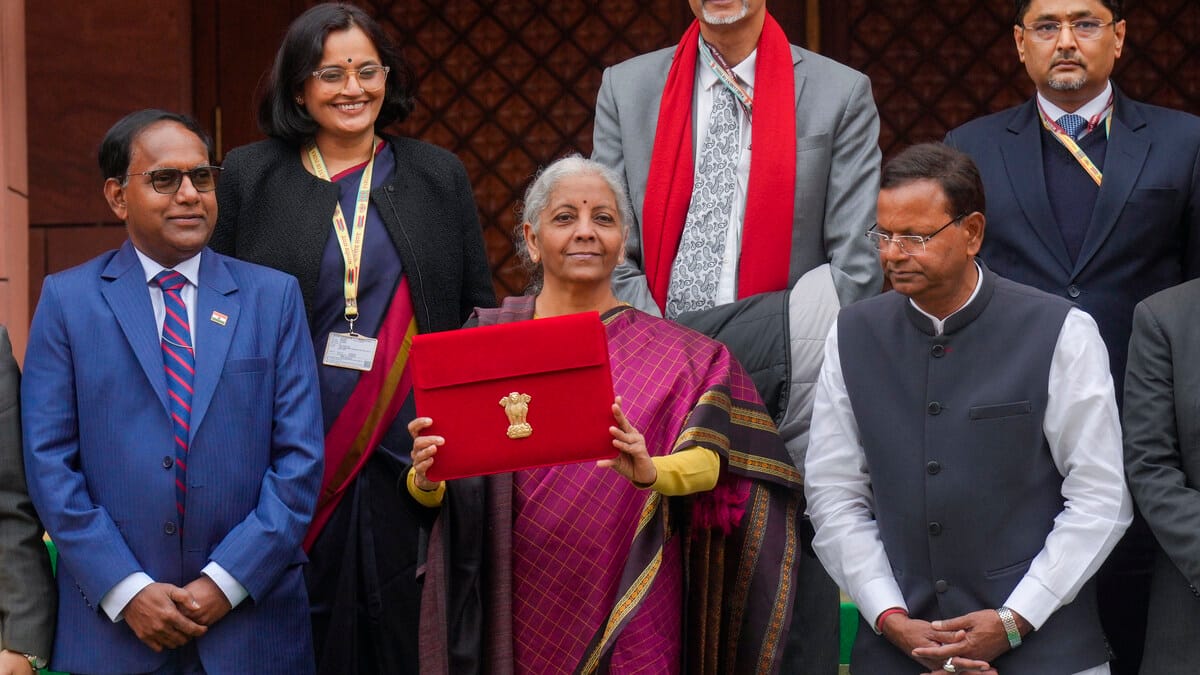 Image Source: PTI
February 1, 2026 | 10:23 AM IST
Education Budget 2026 LIVE: Government spent less than 20% for minority scholarships
The data shared by the Ministry of Minority Affairs during the 2025 monsoon session of Parliament shows that less than one-third of the funds allocated to three major scholarship schemes for minority students were utilised in the previous financial year.
The allocations and utilisation of funds for the three minority scholarships for the financial year 2025-26 were as follows.
Scheme | Allocation (Rs crore) | Utilisation (Rs crore) | % Utilised |
Pre-matric scholarship | 90 | 1.55 | 1.72% |
Post-matric scholarship | 343.91 | 5.31 | 1.54% |
Merit-cum-means scholarship | 19.41 | 3.50 | 18.04% |
February 1, 2026 | 10:04 AM IST
Education Budget LIVE 2026: FM with her team in front of Kartavya Bhavan
FM Nirmala Sitharaman called on President Droupadi Murmu before presenting her record ninth Budget in the Lok Sabha. As per established tradition, the FM met the President at the Rashtrapati Bhavan before heading to Parliament. Sitharaman continues with the tradition she set in 2019, carrying the budget speech in a 'bahi-khata', which she used after dropping the briefcase tradition. With inputs from PTI
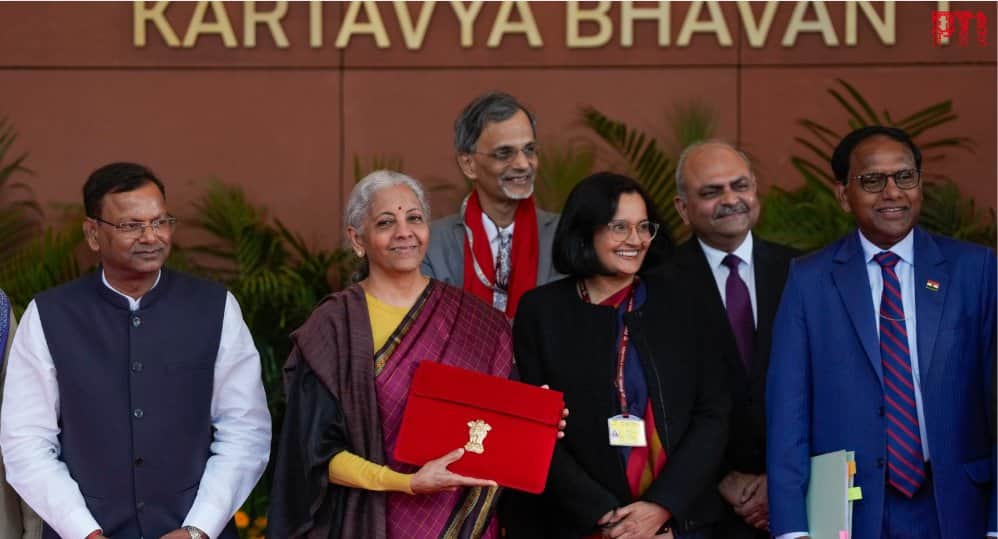 Image: PTI official X account
February 1, 2026 | 09:49 AM IST
Education Budget 2026 LIVE: Samagra Shiksha Abhiyan outlay saw rise
In 2025-26 Education Budget highlights, the funding to Samagra Shiksha Abhiyan went up from Rs 37,010 crore to Rs 41,250 crore, reflecting a rise of 11.46%.
Scheme | 2022-23 | 2023-24 | 2024-25 | 2025-26 |
Samagra Shiksha Abhiyan | 37,383 | 37,453 | 37,010 | 41,250 |
February 1, 2026 | 09:36 AM IST
Education Budget 2026 LIVE: What is expected in Budget 2026 in India?
Vikas Singh, the chief growth officer at Mohan Babu University said: “As we look ahead to Budget 2026, the focus should be on strengthening the entire education value chain so it meaningfully supports India’s growth story. Beyond funding, we need targeted investment in technology-enabled learning, skill integration across programmes, and initiatives that bridge academia with emerging industries. Prioritising scalable digital platforms, student-centric financing, and regional education clusters will help democratise access and ensure graduates are ready for tomorrow’s opportunities.”
February 1, 2026 | 09:26 AM IST
How many union budgets have been presented by Nirmala Sitharaman? 5 facts
This year, FM Nirmala Sitharaman will present the ninth Budget 2026-27.
- The former FM Morarji Desai presented the Union Budget a record 10 times. PM Jawaharlal Nehru was the first PM to present the Union Budget for the FY 1958-59.
- The first woman to present the Budget was Indira Gandhi in 1970. Nirmala Sitharaman is the second woman to do so.
- Nirmala Sitharaman presented the first 'Paperless Budget' on 1 February 2021.
- The longest Budget speech record has been held by Sitharaman, 2 hours and 42 minutes long in 2020.
- The timing of the budget presentation was changed from 5 pm to 11 am in the year 1999.
February 1, 2026 | 09:09 AM IST
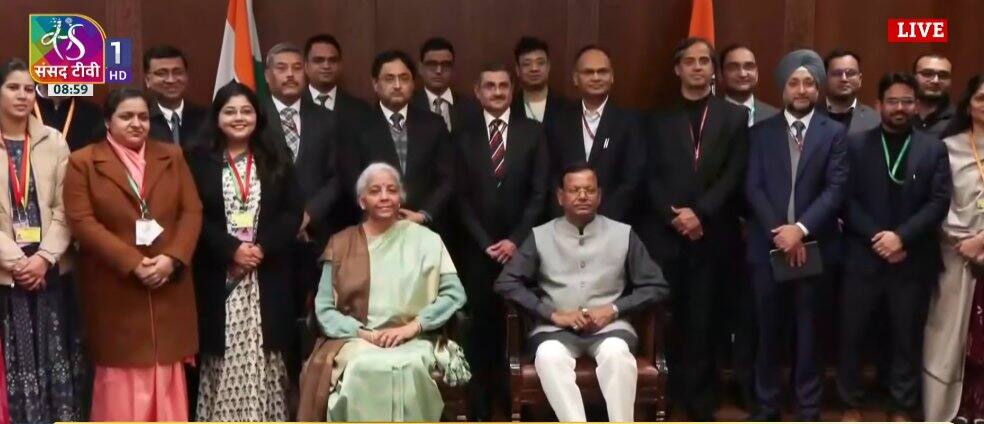
Education Budget 2026 LIVE: FM with her team
The Union finance minister Nirmala Sitharaman and MoS Pankaj Chaudhary with their team, for the Union Budget 2026-27.
 (Image: ANI X account)
February 1, 2026 | 09:00 AM IST
Education Budget 2026 LIVE: Budget utilisation has improved since COVID, says government data
According to actual expenditure data shared by the Ministry of Education with the Rajya Sabha during the winter session of Parliament, the utilisation of the education budget has improved significantly since the Covid-19 pandemic
Financial Year | Budget Estimates (In Rs. Crore) | Actual Expenditure (In Rs Crore) | % Utilised |
2019-20 | 94,853.64 | 89,529.10 | 94.39 |
2020-21 | 99,311.52 | 84,026.71 | 84.58 |
2021-22 | 93,224.31 | 80,829.64 | 86.68 |
2022-23 | 1,04,277.72 | 97,885.00 | 93.87 |
2023-24 | 1,12,899.47 | 1,11,408.39 | 98.68 |
2024-25 | 1,21,117.87 | 1,10,477.28 | 91.22 |
The ministry spent more than 91% of its allocated budget for the financial year 2024–25, amounting to Rs 1,10,477.28 crore.
While this represents a drop from the utilisation level of about 98.7% in 2023–24, it is a significant improvement compared to the pandemic years of 2020–21 and 2022–23, when utilisation remained around 85%.
The lowest utilisation—84.5%—was recorded in 2020–21.
February 1, 2026 | 08:53 AM IST
Education Budget 2026 LIVE: Founders call for equity over Gross Enrolment Ratio (GER)
Referring to the Economic Survey 2024-25, founder and chancellor of Medhavi Skills University Pravesh Dudani noted that while the number of higher education institutions has risen by 13.8% and the Gross Enrolment Ratio has increased from 23.7% to 28.4% over the past eight years, budgetary priorities should now shift toward enhancing access, quality, and educational outcomes.
He added that increased funding for academic and digital infrastructure is essential to convert innovation into industry-ready solutions, and that targeted fiscal incentives could further strengthen the apprenticeship ecosystem and encourage industry collaboration.
February 1, 2026 | 08:44 AM IST
Today's Budget Announcement: Budget to give fresh momentum to Delhi's development, says Delhi CM
Delhi chief minister Rekha Gupta expressed confidence that the upcoming Union Budget 2026-27 will have a positive impact on the city's development plans. In a statement, the CM exuded confidence that the Union Budget will also support the goal of building a developed Delhi.
With inputs by PTI
February 1, 2026 | 08:31 AM IST
Union Budget 2026 LIVE streaming at 11 am
As per the latest ANI updates, the Union FM Nirmala Sitharaman has left her residence for the Ministry of Finance, ahead of the presentation of the Union Budget 2026-27 today.
February 1, 2026 | 08:27 AM IST
Education Sector Budget Expectation 2026:
Anjali Sane the professor and dean School of Economics and Commerce and Vishwanath Karad MIT World Peace University, Pune said:
“Education plays an important role in developing the capacity of human resources in any nation. It is rightly called a ‘merit good’ in economics, because it shapes the future and destiny of the nation. The Union Budget is a crucial tool to guide and shape education in India. While developed countries spend over 10 per cent of GDP on education, India, as an emerging economy with a demographic dividend, allocates only around 4 to 5 per cent. Budget allocations show a focus on school education, reflecting NEP 2020 priorities, while higher education receives selective support. With high GDP growth, rising digital divides, skill gaps among graduates, and the goal of Viksit Bharat 2047, the upcoming budget must increase allocations for education, bridge the digital divide, match learning with market-relevant skills, and ensure long-term human resource development. These steps are essential to strengthen India’s global identity and sustainable economic growth.”
February 1, 2026 | 08:27 AM IST
Where to watch Budget 2026 speech LIVE?
February 1, 2026 | 08:15 AM IST
Budget 2026 Is a 'Golden Opportunity' for education reform, says Nirvaan Birla
As India heads into Union Budget 2026, the education sector is looking for deeper implementation rather than sweeping policy changes. With clear intent around digital learning, AI readiness, and skills-embedded education, the ecosystem is well placed to execute at scale.
Sharing pre-budget perspective, Nirvaan Birla, the managing director of Birla Open Minds Education Ltd., says: “The upcoming budget is a golden opportunity to fuel India’s journey toward becoming a global talent powerhouse. By deepening the focus on teacher empowerment, we can turn the vision of the National Education Policy into a reality. The future belongs to a nation that invests in its learners today, ensuring every student has the tools to thrive in a digital-first world. As we head into #Budget2026, there’s a lot to feel positive about. The intent around digital learning, AI readiness, skills-embedded education and innovation is clear there, and with over 2 lakh recognised startups, the capacity to execute also exists.”
February 1, 2026 | 08:13 AM IST
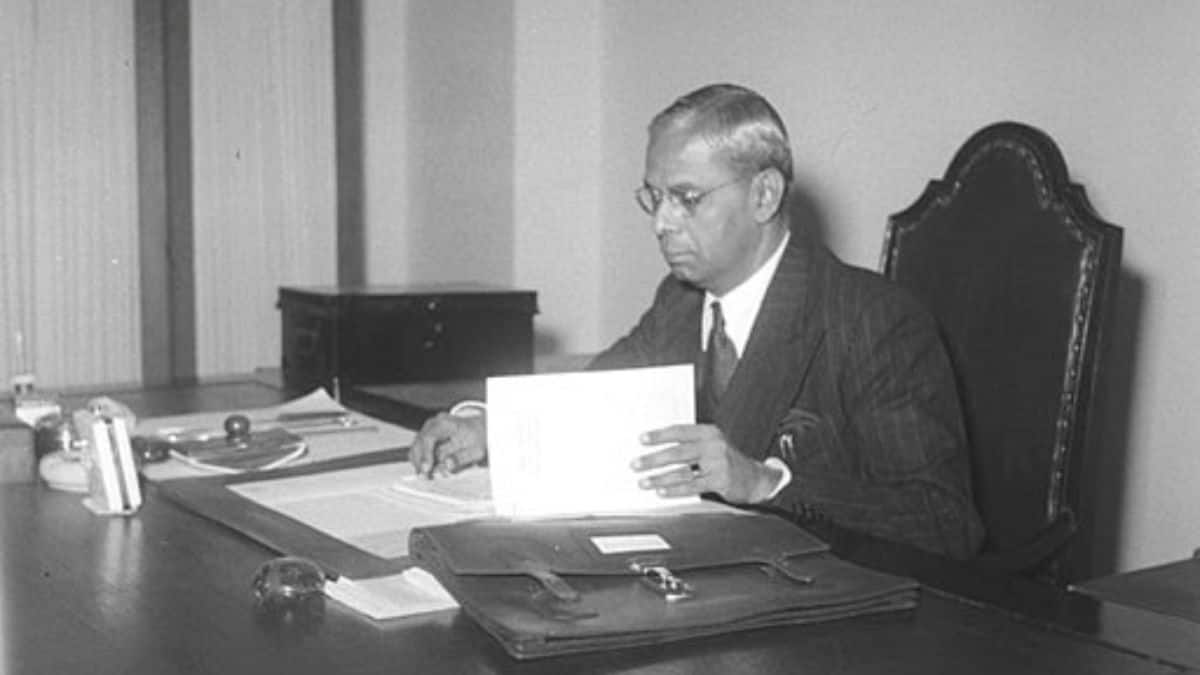
When was first Union Budget presented in India?
India’s first Union Budget was presented on November 26, 1947, by the country’s first finance minister, RK Shanmukham Chetty.
 RK Shanmukham Chetty (Image: Wikimediacommons)
February 1, 2026 | 08:06 AM IST
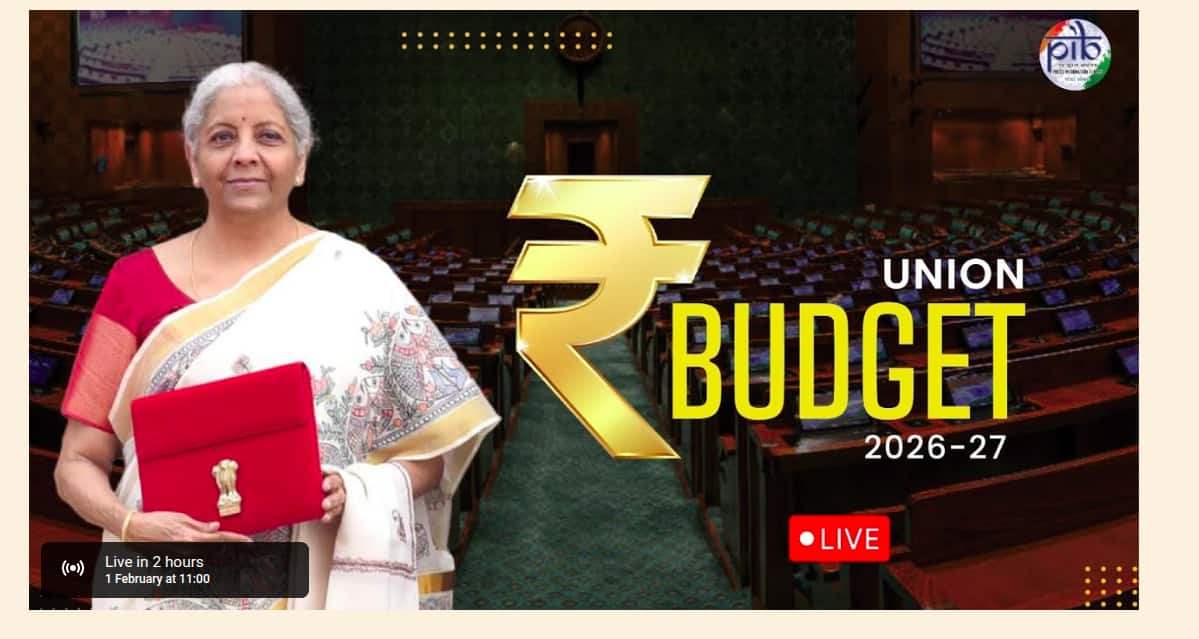
Where to watch Budget 2026 LIVE?
The Budget 2026-27 will be live webcast on the Press Information Bureau's YouTube channel, PIB India.
 Budget 2026-27 live updates. (Image: PIB website)
February 1, 2026 | 07:53 AM IST
Union Budget 2026: Education sector budget cut
The budget allocation for educational institutions for last year, as compared to 2024-25 was as follows.
Institutions | 2024-25 (In Rs Cr) | 2025-26 (In Rs Cr) |
UGC | 2,500 | 3,335.97 |
IIT | 10,324.50 | 11,349.50 |
IIM | 212.12 | 251.89 |
IISER | 1,540 | 1353.33 |
IISC | 918.27 | 900.00 |
NIT/IIEST | 5,040 | 5687.47 |
Central Universities | 15,928 | 16691.31 |
 Image Source: Facebook
February 1, 2026 | 07:45 AM IST
Education Budget in India 2026
Last year, a total of Rs 1.28 lakh crore was allotted to the education sector, reflecting a 6.65% rise from the 2024-25 fiscal year. The department of school education and literacy under the education ministry was allocated Rs 78,572 crore, showing an increase of 7.62%.
February 1, 2026 | 07:22 AM IST
Education Budget 2026: What is the Budget Speech time today?
The Budget 2026 speech is scheduled for today, with the finance minister expected to begin her address at 11 am. This year's Budget presentation will be FM Nirmala Sitharaman's 9th consecutive, marking her the first FM in India to achieve this milestone.
January 31, 2026 | 10:15 PM IST
CA association calls for globally aligned professional education in Budget 2026
The Association of Chartered Certified Accountants (ACCA), a global accounting body representing more than 2.57 lakh members and over 5.3 lakh aspiring professionals in 180 countries, said the 2026 education budget should prioritise world-class professional education that meets global benchmarks and encourages stronger collaboration between industry and academic institutions.
January 31, 2026 | 09:15 PM IST
What time is Budget 2026 tomorrow?
The Union Budget speech 2026 will be delivered by finance minister Nirmala Sitharaman at 11 am in the Parliament. However, expenditures, revenue statements and others will be published on the India Budget official website, indiabudget.gov.in, later on February 1.
January 31, 2026 | 08:45 PM IST
Education Budget 2026: FM will present Budget in paperless format
The General Budget 2026-27 will be presented by finance minister Nirmala Sitharaman in paperless format. This marks the sixth consecutive year the budget has been delivered digitally than red leather briefcase.
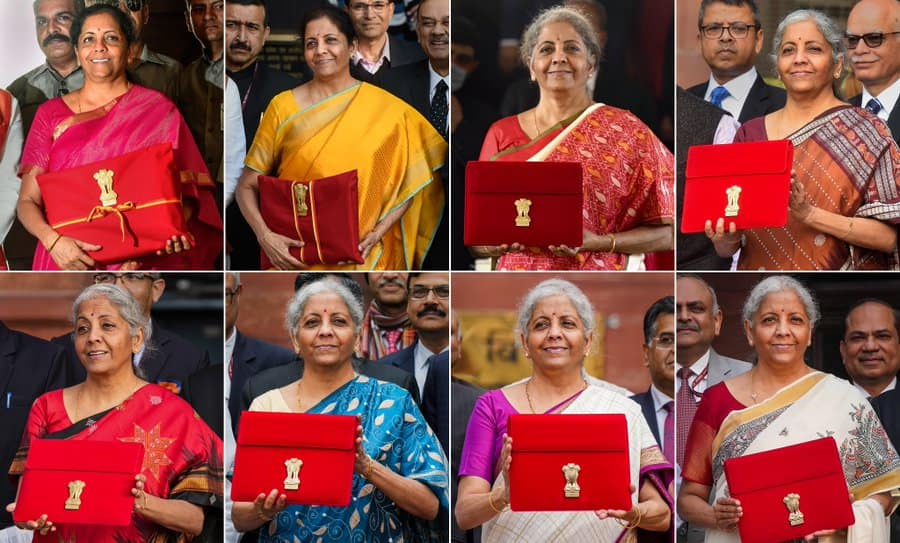 Nirmala Sitharaman with Budget document. (Source: PTI)
January 31, 2026 | 08:15 PM IST
Nirmala Sitharaman to interact with 30 college students after budget speech
The Union finance minister Nirmala Sitharaman will interact with 30 college students after her Budget 2026 speech on February 1. Selected college students will also get to witness a live presentation of the Union Budget from the Lok Sabha gallery.
This initiative aims to provide exposure to promote greater awareness among students about finance, economics, governance, and democratic processes, the PTI reported.
January 31, 2026 | 07:22 PM IST
Budget session 2026 in Parliament
The Budget session for the financial year 2026-27 began on January 28, with President Droupadi Murmu addressing members of both Rajya Sabha and Lok Sabha. The first phase of the session will conclude on February 13, and will resume on March 9.
January 31, 2026 | 07:08 PM IST
Budget 2026 date and time
The Union finance minister Nirmala Sitharaman will present the ninth Budget 2026 tomorrow. She is one short of the record 10 Budgets presented by ex-finance minister Morarji Desai. For the first time, the Union Budget will be tabled on a Sunday.
January 31, 2026 | 03:54 PM IST
Budget day formalities: What happens before Budget speech 2026
On Budget day, the Union Cabinet meeting is held first, where final approval is given to the Budget documents. This is followed by the customary ‘halwa ceremony’, the final stage of Budget preparation and the lock-in period for officials involved.
The finance minister Nirmala Sitharaman will arrive at Parliament with the Budget documents and meet the President before the speech. The Budget speech will be delivered at 11 am.
Next Story
]Latest Education News
]Related News
]Maharashtra resident doctors to go on indefinite strike from Aug 5
Bengal: ISI faculty, students urge Centre not to proceed with proposed Bill without talks
MoSPI tables Indian Statistical Institute Bill as ISI Kolkata teachers, students protest over autonomy concern


